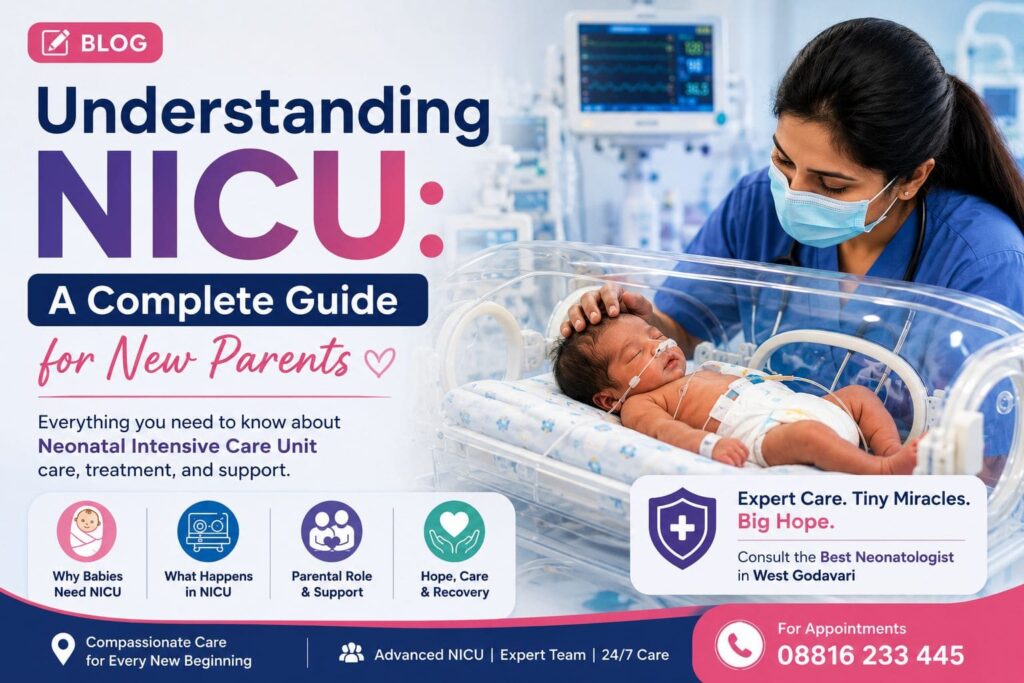
Everything You Need to Know from the Best Neonatologist in West Godavari
Hearing that your newborn baby needs to be admitted to the NICU can be one of the most emotional and overwhelming moments for any parent. You may feel scared, confused, helpless, and uncertain about what lies ahead. Questions begin to flood your mind: Is my baby okay? Why does my baby need special care? How long will they stay in the NICU? Can I be with my baby?
If you’re experiencing these emotions right now, you’re not alone.
At Motherness Hospital, Bhimavaram, we understand how stressful this journey can be. Our NICU team, led by some of the most experienced neonatal specialists, is dedicated to providing advanced medical care while supporting families every step of the way. This guide will help you understand what the NICU is, why babies need it, what happens inside, and how you can actively participate in your baby’s care.
What is NICU?
NICU stands for Neonatal Intensive Care Unit.
It is a specialized hospital unit designed to care for newborn babies who need extra medical attention after birth. These babies may be born prematurely, have a low birth weight, experience breathing difficulties, develop infections, or require specialized monitoring and treatment.
The NICU combines advanced medical technology with highly trained healthcare professionals, including neonatologists, neonatal nurses, respiratory therapists, and pediatric specialists, to provide round-the-clock care.
Think of the NICU as a safe and supportive environment where babies receive the specialized care they need to grow stronger and healthier.
Why Do Babies Go to the NICU?
Many parents assume that NICU admission means something is seriously wrong. However, that’s not always the case.
Some babies need NICU care for only a few days, while others may require longer support depending on their condition.
Common reasons a baby may be admitted to the NICU include:
Premature Birth
Babies born before 37 weeks of pregnancy are considered premature. Their lungs, digestive system, immune system, and other organs may not be fully developed yet.
The NICU helps support these vital functions while the baby continues to grow.
Low Birth Weight
Babies weighing less than 2.5 kilograms at birth often need additional monitoring and nutritional support.
Breathing Difficulties
Some newborns may struggle to breathe independently due to immature lungs, infections, or complications during delivery.
Specialized breathing support can help them recover safely.
Infections
Newborns have delicate immune systems. Even minor infections can become serious if not treated promptly.
Jaundice
High bilirubin levels can cause jaundice in newborns. While mild jaundice is common, severe cases may require NICU monitoring and treatment.
Birth Complications
Certain delivery-related complications may require temporary observation and specialized care after birth.
What Are the Different Levels of NICU Care?
Not all NICUs provide the same level of care. Understanding these levels can help parents know what services are available.
Level I: Basic Newborn Care
For healthy newborns who need routine monitoring and care.
Level II: Special Care Nursery
For babies who are moderately premature or require short-term medical support.
Level III: Advanced NICU
Provides comprehensive care for critically ill or very premature babies.
Level IV: Highest Level of Neonatal Care
Offers advanced surgical and intensive care services for complex newborn conditions.
At Motherness Hospital, Bhimavaram, our NICU is equipped with advanced technology and experienced neonatal specialists to provide comprehensive care for vulnerable newborns.
What Happens Inside the NICU?
Walking into the NICU for the first time can feel intimidating.
You may see incubators, monitors, tubes, alarms, and healthcare professionals moving quickly around the unit. While this can seem overwhelming, each piece of equipment serves an important purpose in helping babies recover and thrive.
Incubators
Incubators create a warm, controlled environment that helps regulate a baby’s body temperature.
Monitors
These continuously track important vital signs such as:
- Heart rate
- Breathing rate
- Oxygen levels
- Blood pressure
Feeding Support
Some babies cannot feed by mouth immediately after birth. They may receive nutrition through specialized feeding tubes until they are strong enough to breastfeed or bottle-feed.
Respiratory Support
Babies experiencing breathing difficulties may receive support through oxygen therapy, CPAP, or ventilators.
Phototherapy Units
Special lights help treat newborn jaundice safely and effectively.
Is My Baby Safe in the NICU?
This is one of the most common concerns parents have.
The answer is yes.
The NICU is specifically designed to provide the highest level of safety and medical care for newborns who need extra support.
Highly trained neonatal teams monitor babies around the clock. Every heartbeat, breath, and vital sign is carefully observed to ensure prompt intervention if needed.
Many babies who begin life in the NICU go on to grow into healthy children, teenagers, and adults.
Can Parents Visit Their Baby in the NICU?
Most modern NICUs encourage parental involvement because it plays a crucial role in a baby’s emotional and physical development.
Policies may vary depending on hospital guidelines, but parents are usually encouraged to:
- Visit regularly
- Participate in caregiving activities
- Learn feeding techniques
- Practice skin-to-skin care
- Communicate with the NICU team
Always follow your hospital’s infection control and visitation guidelines.
What is Kangaroo Care?
Kangaroo Care, also known as skin-to-skin care, involves placing your baby directly on your chest.
This simple yet powerful practice can provide several benefits:
- Stabilizes heart rate
- Improves breathing
- Supports weight gain
- Promotes bonding
- Encourages breastfeeding
- Reduces parental stress
Even babies in the NICU may be able to participate in Kangaroo Care under medical supervision.
Can Mothers Breastfeed Babies in the NICU?
Absolutely.
Breast milk is especially beneficial for premature and medically fragile babies.
Even if your baby cannot breastfeed directly, mothers can express milk, which can be given through feeding tubes or specialized feeding methods.
Breast milk provides:
- Essential nutrients
- Antibodies that fight infections
- Better digestive support
- Improved long-term developmental outcomes
NICU staff can guide mothers through the process and provide lactation support when needed.
How Long Do Babies Stay in the NICU?
This is one of the most difficult questions because every baby is unique.
The length of stay depends on factors such as:
- Gestational age
- Birth weight
- Medical condition
- Feeding ability
- Breathing independence
- Overall growth and development
Some babies stay only a few days, while others may require weeks or months of care.
Rather than focusing on a specific discharge date, healthcare providers usually monitor milestones that indicate readiness to go home.
Signs Your Baby Is Ready to Leave the NICU
Before discharge, most babies demonstrate the ability to:
- Maintain body temperature independently
- Feed successfully
- Gain weight consistently
- Breathe without significant support
- Maintain stable vital signs
Parents are also educated about newborn care before taking their baby home.
How to Cope Emotionally When Your Baby Is in the NICU
Having a baby in the NICU can be emotionally exhausting.
Many parents experience:
- Anxiety
- Guilt
- Fear
- Sadness
- Frustration
- Sleep disturbances
These feelings are completely normal.
Some helpful coping strategies include:
Stay Informed
Ask questions and stay involved in your baby’s care plan.
Take Care of Yourself
Rest, eat nutritious meals, and seek emotional support when needed.
Connect with Other NICU Parents
Many families find comfort in talking to others who have had similar experiences.
Celebrate Small Victories
Every milestone matters, whether it’s gaining weight, breathing independently, or completing a feeding.
Common Myths About NICU Care
Myth 1: NICU Means My Baby Is Critically Ill
Not necessarily. Many babies are admitted simply for observation or short-term support.
Myth 2: Parents Cannot Be Involved
Modern NICUs encourage active parental participation whenever possible.
Myth 3: Premature Babies Cannot Thrive
Advances in neonatal medicine have dramatically improved outcomes for premature babies.
Myth 4: NICU Babies Will Always Have Health Problems
Many NICU graduates grow up healthy and achieve normal developmental milestones.
Choosing the Right NICU and Neonatal Team
When evaluating a NICU, parents should consider:
- Availability of experienced neonatologists
- Advanced neonatal equipment
- Infection control protocols
- Family-centered care approach
- Emergency support services
- Breastfeeding and parental support programs
The expertise of the neonatal team can make a significant difference in outcomes and parental confidence.
Why Parents Trust Motherness Hospital, Bhimavaram
At Motherness Hospital, we understand that every newborn deserves the best possible start in life.
Our NICU combines advanced technology, compassionate care, and evidence-based treatment protocols to support babies who need specialized neonatal care.
Families choose Motherness Hospital because of our commitment to:
- Advanced neonatal monitoring
- Comprehensive NICU services
- Family-centered care
- Compassionate nursing support
- Modern infrastructure
- Experienced neonatal specialists
If you are looking for the Best Neonatologist in West Godavari, our dedicated team is here to provide expert care and guidance throughout your baby’s journey.
Final Thoughts
Having a baby in the NICU can be one of the most challenging experiences a family faces. While the environment may initially seem overwhelming, remember that the NICU exists for one purpose—to help your baby grow stronger, healthier, and ready for life outside the hospital.
Every day in the NICU is a step forward. Every gram gained, every successful feed, and every milestone achieved brings your baby closer to going home.
At Motherness Hospital, Bhimavaram, we stand beside families during every stage of this journey, providing expert neonatal care with compassion, transparency, and hope.
If you have concerns about your newborn or need expert neonatal guidance, consult the Best Neonatologist in West Godavari at Motherness Hospital and ensure your baby receives the specialized care they deserve.