A Complete Guide from the Best Fertility Hospital in West Godavari
Infertility can be one of the most emotionally challenging experiences a couple may face. When months or even years of trying to conceive do not result in pregnancy, feelings of disappointment, uncertainty, and frustration can begin to take a toll. For some couples, especially those dealing with poor egg quality, low ovarian reserve, premature ovarian insufficiency, or repeated IVF failures, donor egg IVF offers renewed hope and a realistic path toward parenthood.
At Motherness Hospital, recognized by many families as the Best Fertility Hospital in West Godavari, we understand that considering donor egg IVF is not just a medical decision—it is an emotional journey. Many couples have questions about how the process works, who may benefit from it, success rates, safety, costs, and what to expect at every stage.
This comprehensive guide explains donor egg IVF step by step, helping you make informed decisions with confidence and clarity.
What Is Donor Egg IVF?
Donor egg IVF is an advanced fertility treatment in which eggs from a healthy donor are fertilized with sperm in a laboratory to create embryos. These embryos are then transferred into the intended mother’s uterus (or a gestational carrier’s uterus, if required).
The resulting child is genetically related to the sperm provider but not genetically related to the egg recipient. However, the recipient experiences the pregnancy, childbirth, and early nurturing process.
For many couples who cannot conceive using their own eggs, donor egg IVF offers one of the highest success rates among fertility treatments.
Who May Need Donor Egg IVF?
Donor egg IVF is recommended in several situations.
1. Women with Low Ovarian Reserve
Some women produce fewer eggs than expected for their age. Conditions such as low AMH levels or diminished ovarian reserve may significantly reduce the chances of successful conception with their own eggs.
2. Age-Related Fertility Decline
As women age, both egg quantity and egg quality decline. Women above 40 often experience reduced IVF success rates using their own eggs, making donor eggs a highly effective alternative.
3. Premature Ovarian Insufficiency (POI)
Some women stop producing viable eggs earlier than expected due to premature ovarian insufficiency, also known as premature ovarian failure.
4. Multiple Failed IVF Cycles
Couples who have undergone several unsuccessful IVF attempts may benefit from donor egg IVF, particularly when poor egg quality is identified as the primary cause.
5. Genetic Disorders
Women carrying certain inherited genetic conditions may choose donor eggs to reduce the risk of passing these conditions to their children.
6. Same-Sex Male Couples and Single Intended Fathers
Donor egg IVF, combined with gestational surrogacy, can help same-sex male couples and single men build families.
Donor Egg IVF vs Regular IVF
Understanding the difference between traditional IVF and donor egg IVF can help couples determine which option may be most suitable.
Regular IVF | Donor Egg IVF |
Uses the woman’s own eggs | Uses eggs from a donor |
Success depends heavily on egg quality and age | Success primarily depends on donor egg quality |
Lower success rates after age 40 | Higher success rates regardless of recipient’s age |
Genetic link to both parents | Genetic link to sperm provider |
For women with severely diminished ovarian reserve or poor egg quality, donor egg IVF often provides significantly better pregnancy outcomes.
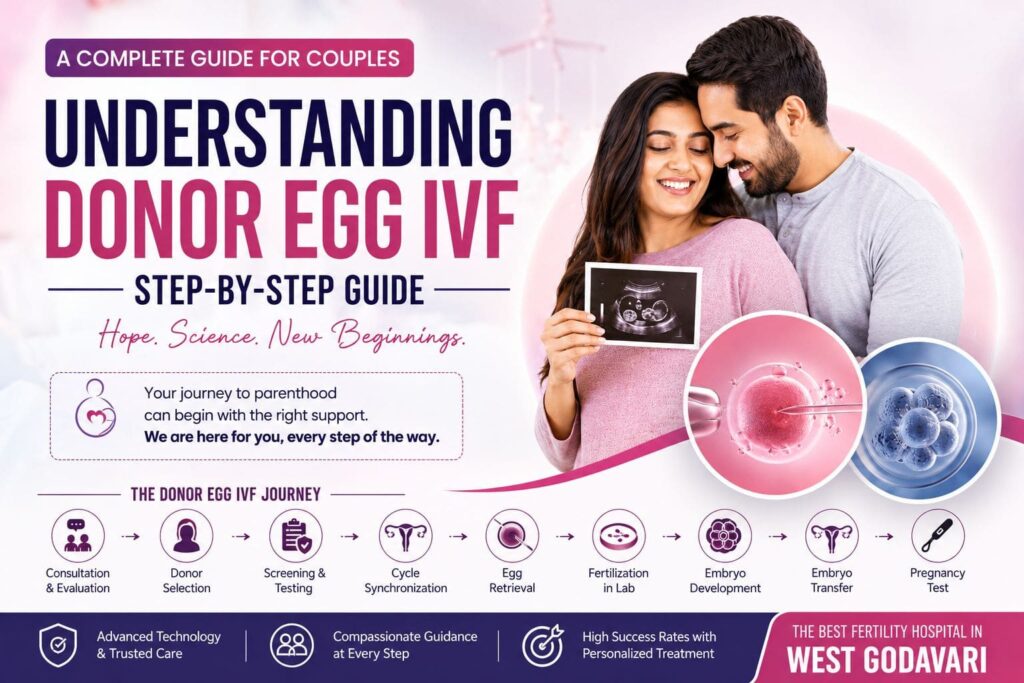
Step-by-Step Process of Donor Egg IVF
Understanding each stage can reduce anxiety and help couples feel prepared throughout the journey.
Step 1: Initial Fertility Consultation
The process begins with a detailed consultation with a fertility specialist.
During this visit, your doctor may:
- Review medical and fertility history
- Evaluate previous fertility treatments
- Perform hormone testing
- Assess uterine health
- Discuss treatment goals and expectations
This is also the time to ask questions about donor selection, timelines, costs, and success rates.
Step 2: Choosing an Egg Donor
Selecting an egg donor is one of the most important parts of the process.
Donors are typically screened extensively for:
- Medical history
- Genetic conditions
- Infectious diseases
- Psychological health
- Reproductive health
Many couples choose donors based on characteristics such as:
- Physical appearance
- Height
- Skin tone
- Eye color
- Educational background
- Ethnicity
Anonymous vs Known Donors
Anonymous Donors
The identities of both donor and recipient remain confidential.
Known Donors
A friend or relative may volunteer to donate eggs. Legal and counseling guidance is usually recommended in such situations.
At the Best Fertility Hospital in West Godavari, donor selection follows strict ethical, legal, and medical guidelines to ensure safety and transparency.
Step 3: Donor Screening and Evaluation
Before proceeding, donors undergo comprehensive testing.
This typically includes:
- Blood tests
- Genetic screening
- Hormonal evaluation
- Ultrasound scans
- Infectious disease testing
The goal is to ensure that only healthy, qualified donors participate in the program.
Step 4: Synchronization of Cycles
For fresh donor egg cycles, the donor’s menstrual cycle and the recipient’s cycle are synchronized.
Hormonal medications are used to:
- Prepare the donor for egg retrieval
- Prepare the recipient’s uterus for embryo implantation
This coordination helps maximize the chances of successful embryo transfer.
In frozen donor egg cycles, synchronization is often simpler because the eggs are already retrieved and stored.
Step 5: Donor Egg Retrieval
The donor undergoes ovarian stimulation using fertility medications to encourage multiple eggs to mature.
Once the eggs are ready, a minor outpatient procedure called egg retrieval is performed.
The procedure:
- Usually takes 15–30 minutes
- Is performed under sedation
- Causes minimal discomfort
- Allows quick recovery
The collected eggs are then transported to the embryology laboratory.
Step 6: Fertilization in the Laboratory
The retrieved donor eggs are fertilized using sperm from the intended father or donor sperm.
Fertilization may occur through:
Conventional IVF
Eggs and sperm are combined naturally in the laboratory.
ICSI (Intracytoplasmic Sperm Injection)
A single sperm is injected directly into the egg, often used when male factor infertility exists.
Successfully fertilized eggs begin developing into embryos.
Step 7: Embryo Development and Monitoring
Embryologists carefully monitor embryo growth over several days.
Embryos are evaluated based on:
- Cell division
- Growth patterns
- Morphology
- Overall quality
The healthiest embryos are selected for transfer.
In some cases, genetic testing may be recommended before embryo transfer.
Step 8: Preparing the Recipient’s Uterus
The recipient receives hormone medications to prepare the uterine lining.
A healthy uterine lining is essential for implantation and pregnancy success.
Doctors monitor:
- Endometrial thickness
- Hormonal levels
- Overall uterine readiness
Once optimal conditions are achieved, embryo transfer is scheduled.
Step 9: Embryo Transfer
Embryo transfer is a simple, painless procedure.
A thin catheter is used to place the selected embryo into the uterus.
The procedure:
- Requires no surgery
- Usually takes only a few minutes
- Does not require hospitalization
Most patients return to normal activities shortly afterward.
Step 10: Pregnancy Test
Approximately 10–14 days after embryo transfer, a blood pregnancy test is performed.
This waiting period can be emotionally challenging, but support from fertility specialists, counselors, and loved ones can make a significant difference.
If the test is positive, follow-up ultrasounds confirm the pregnancy.
What Are the Success Rates of Donor Egg IVF?
One of the biggest advantages of donor egg IVF is its high success rate.
Because donor eggs usually come from young, healthy women, embryo quality tends to be excellent.
While individual outcomes vary, donor egg IVF often provides:
- Higher implantation rates
- Higher pregnancy rates
- Lower miscarriage rates compared to IVF using poor-quality eggs
For women above 40, donor egg IVF frequently offers substantially better outcomes than standard IVF with their own eggs.
Fresh vs Frozen Donor Eggs
Couples often wonder whether fresh or frozen donor eggs are better.
Fresh Donor Eggs
Advantages:
- More eggs available
- Potentially more embryos created
- Greater flexibility in embryo selection
Frozen Donor Eggs
Advantages:
- Faster treatment timeline
- Lower logistical complexity
- More convenient scheduling
Both options can be highly successful when managed by experienced fertility specialists.
Risks and Safety of Donor Egg IVF
Donor egg IVF is generally considered safe.
However, like all medical procedures, certain risks exist.
Potential Risks for Recipients
- Medication side effects
- Multiple pregnancy (if multiple embryos are transferred)
- Pregnancy complications related to age or existing health conditions
Potential Risks for Donors
- Temporary discomfort from ovarian stimulation
- Minor risks associated with egg retrieval
Comprehensive screening and expert monitoring significantly reduce these risks.
Emotional Aspects of Using Donor Eggs
Many couples experience mixed emotions when considering donor egg IVF.
Common feelings include:
- Grief over not using their own genetic material
- Anxiety about treatment outcomes
- Concern about future disclosure to children
- Fear of judgment from others
These feelings are completely normal.
Many parents report that once pregnancy begins and they welcome their child, the emotional bond formed through carrying, nurturing, and raising the child becomes far more important than genetics.
Professional counseling can help couples process emotions and move forward with confidence.
Legal and Ethical Considerations
Donor egg IVF involves important legal and ethical considerations.
These may include:
- Donor consent
- Confidentiality agreements
- Donor anonymity
- Parental rights
- Compliance with fertility regulations
Working with a reputable fertility center ensures that all procedures follow current medical and legal guidelines.
How Much Does Donor Egg IVF Cost?
The cost of donor egg IVF varies depending on several factors.
These include:
- Donor compensation and screening
- Fertility medications
- Laboratory procedures
- Embryo freezing
- Genetic testing
- Number of treatment cycles required
Because every patient’s situation is unique, individualized consultation is the best way to understand expected costs and treatment options.
How Many Cycles May Be Needed?
Some couples achieve pregnancy during their first donor egg IVF cycle, while others may require additional attempts.
Factors influencing success include:
- Uterine health
- Embryo quality
- Maternal health
- Lifestyle factors
Your fertility specialist will discuss realistic expectations based on your individual circumstances.
Why Choose Motherness Hospital for Donor Egg IVF?
When choosing a fertility center, experience, transparency, advanced technology, and compassionate care all matter.
Motherness Hospital, Bhimavaram, is committed to providing personalized fertility solutions tailored to each couple’s unique journey.
Patients seeking the Best Fertility Hospital in West Godavari often choose Motherness Hospital because of:
- Experienced fertility specialists
- Advanced IVF laboratory facilities
- Ethical donor screening protocols
- Personalized treatment plans
- Emotional support throughout treatment
- Patient-centered care and counseling
Every fertility journey is different, and our team is dedicated to guiding couples with empathy, expertise, and hope.
Final Thoughts
Choosing donor egg IVF is a deeply personal decision, but it can also be a life-changing opportunity for individuals and couples facing infertility challenges. Whether you are dealing with low ovarian reserve, age-related infertility, repeated IVF failures, or genetic concerns, donor egg IVF offers one of the most effective pathways to achieving pregnancy and building a family.
The process may seem overwhelming at first, but understanding each step—from consultation and donor selection to embryo transfer and pregnancy testing—can make the journey feel more manageable and empowering.
If you are exploring donor egg IVF and looking for trusted guidance, the team at Motherness Hospital, Bhimavaram, is here to support you every step of the way. With compassionate care, advanced fertility treatments, and a commitment to patient success, we strive to help families turn hope into reality.